
Delivered project · Guantian Aluminum
Machined profiles for storage flow racks and conveyor frames
An automation equipment manufacturer needed profiles and machined parts for heavy-duty storage flow racks and conveyor frames. Guantian coordinated extrusion, machining, anodizing and fit checks so the customer could assemble the labeled parts on its production line.
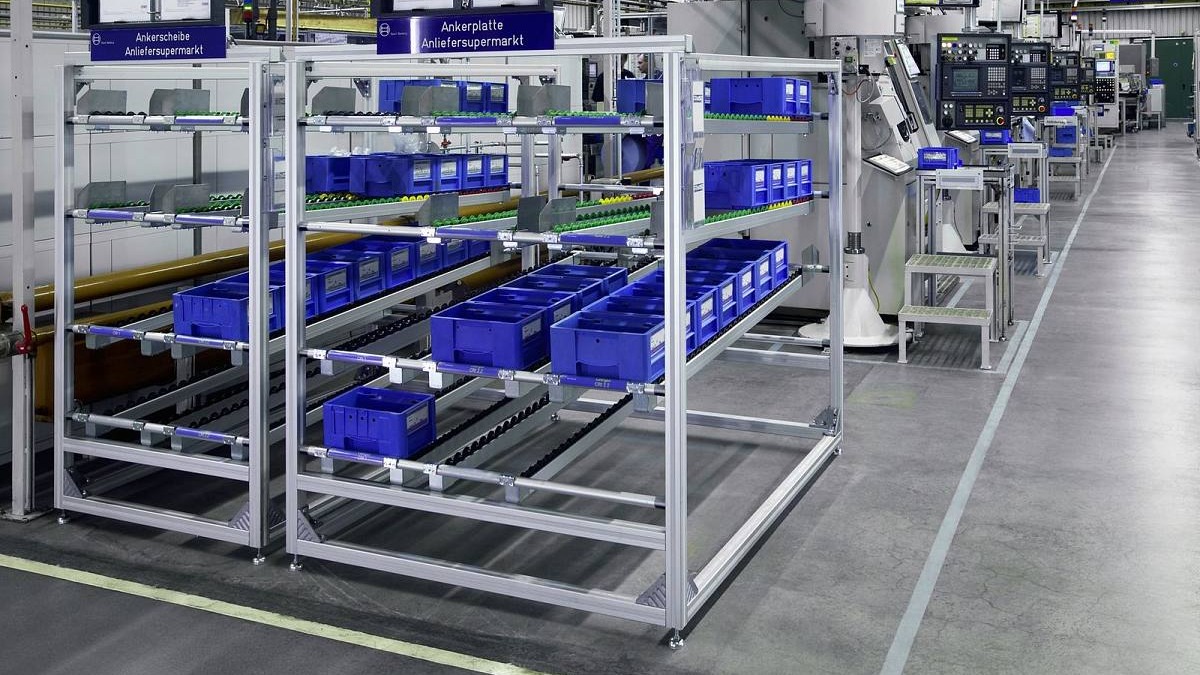
Flow-rack application. This case study describes the profiles and processed parts supplied for customer assembly.
Background and supply scope
The customer was building storage flow racks and conveyor frames for an automated logistics application. Guantian supplied European-style T-slot upright profiles, flow-rack guide profiles and crossbeam connectors. Components were delivered after the agreed precision cutting, punching, drilling, tapping and anodizing operations, ready for the customer's assembly.
Requirements and assembly constraints
The profiles needed to fit directly with linear-bearing sliders, roller tracks and T-bolts at the customer's workshop. Long guide spans required careful control of overall straightness, flatness and open-slot width. Each upright also had multiple connection holes and end threads: accumulated hole-position errors could prevent the rack components from aligning during on-site assembly.
Profile design and production approach
6061-T6 was selected for the project's load-bearing requirements. The die drawings specified the higher precision grade for critical guide-channel dimensions. Guantian completed extrusion, in-line quenching and mechanical stretch straightening in-house to control residual stress and twist, followed by cut-to-length sawing and punching at the specified mounting locations.
An established CNC partner used dedicated fixtures for end tapping and precision countersunk locating holes. A finishing partner then applied the sandblasted, silver-colored anodized finish.
Trial fitting and sample approval
Before die manufacture, the engineering team checked profile interfaces against the roller sliders and T-nuts supplied by the customer. Once the first machined samples were ready, custom GO/NO-GO gauges and the customer's sliders were used to check the full guide length. A frame with intersecting members was trial-assembled in the factory to verify hole alignment. A video of these checks accompanied the samples sent for customer approval. The trial assembly was used to verify the fit of the supplied parts.
Inspection and delivery results
Production batches were inspected and accepted against the approved machining drawings and first-piece samples. Project checks included sampled Webster hardness readings of at least 15 HW, cut-length variation within ±0.5 mm, batch checks for smooth slider movement, thread GO/NO-GO gauging and anodic film thickness of at least 10 µm.
Aluminum chips were removed from the machined parts before they were separated with protective foam and packed. Individual part-number labels matched the customer's bill of materials, allowing the customer to identify the parts for assembly on its production line.
Information for a similar project
Send profile cross-section drawings, machining drawings with hole and thread datums, relevant assembly drawings and a bill of materials. Provide specifications or samples for sliders, roller tracks and connectors, along with span, load and operating-environment requirements. Confirm the finish, quantities, part numbering and packaging plan so we can review the parts against the intended assembly.
The material, dimensional allowances and inspection values in this case apply to this order only. Requirements for each new project are confirmed against its drawings, mating components and approved samples.
Start your project